
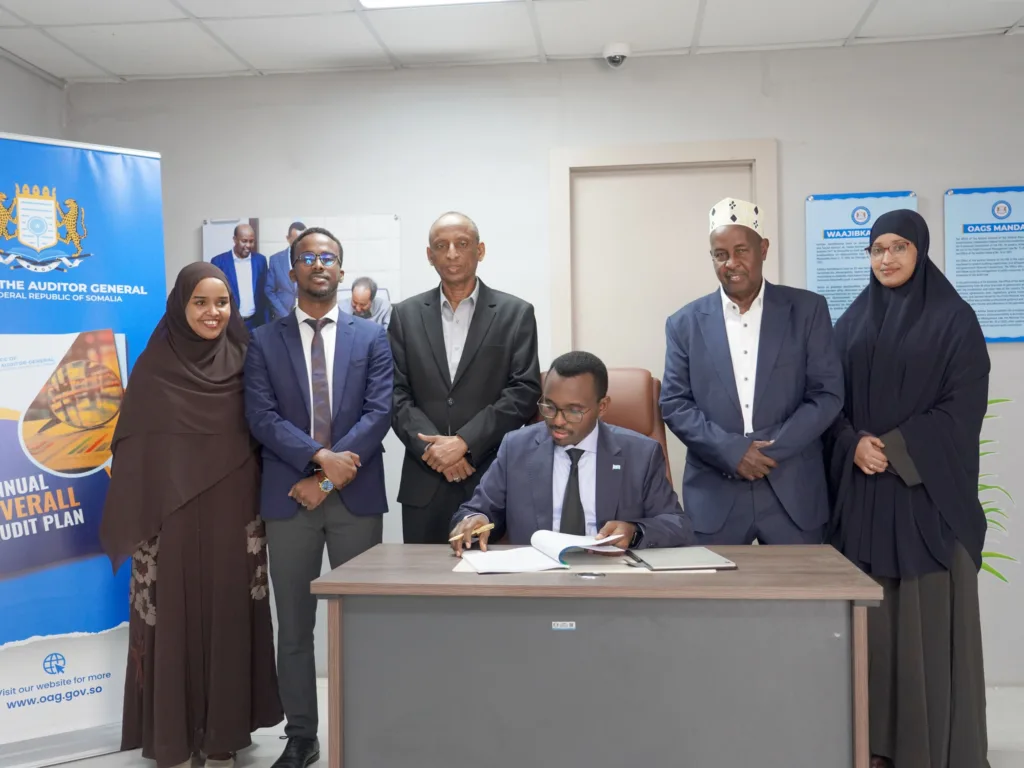
H.E. Mr. Ahmed Hassan Gutale, the Auditor General of Somalia, has officially signed the National Audit Plan for the 2026 fiscal year. This plan represents a major step toward strengthening public financial oversight in Somalia and aims to ensure proper management of public cash flows, services, and government-owned equipment. The initiative reflects the Federal Government of Somalia’s commitment to improving accountability, transparency, and institutional control over national resources.
The signing of the National Audit Plan comes shortly after the Somali Federal Parliament passed the 2026 fiscal budget, one of the largest in the country’s history. However, the approval process sparked serious debate and anger among members of parliament, particularly regarding concerns over transparency and the credibility of national fiscal management. Many legislators expressed dissatisfaction with how previous fiscal years were handled and questioned whether the new budget adequately addressed long-standing accountability gaps.
The National Audit Plan for the 2026 fiscal year is designed to align fully with Somalia’s national audit legislation previously enacted by the Federal Government. This harmonization is intended to strengthen the authority of the Office of the Auditor General and ensure effective oversight of all public financial activities. The plan establishes a regulatory framework to control and monitor government revenues, expenditures, and financial operations across all federal institutions.
One of the key expected outcomes of the 2026 National Audit Plan is a thorough investigation of the processes and procedures used within Somalia’s national payment system. This includes reviewing how public funds are collected, transferred, and disbursed, as well as identifying weaknesses, inefficiencies, or irregularities within the system. Such audits are critical for preventing misuse of funds and improving financial discipline across government institutions.
The audit plan will also play a vital role in reviewing and auditing donations and financial assistance provided to the Somali government by international partners and agencies, including the World Bank and the International Monetary Fund (IMF). Ensuring transparency and accountability in the use of donor funds is essential for maintaining international trust and continued financial support for Somalia’s development and recovery efforts.
During parliamentary debates on the 2026 fiscal budget, lawmakers raised serious concerns about new loans being taken by the government from the IMF and other international financial institutions. Legislators emphasized the need for clear accountability mechanisms, transparent cash-flow tracking, and proper management of loan funds to avoid future debt risks and financial instability.
Somalia’s Budget and Financial Management (BFM) system involves several key stakeholders, including the Ministry of Finance, parliamentary finance committees in both the House of the People and the Upper House, the Office of the Auditor General, and the Central Bank of Somalia. According to national BFM laws, all budgets and financial transactions must follow established government procedures and comply with Somalia’s financial management legislation.
Significant disputes emerged during the closure of the 2025 fiscal year parliamentary session, which was delayed for several months due to misunderstandings between parliamentary BFM committees and the Ministry of Finance. Members of parliament demanded clarification on revenues generated from the sale of national properties, insisting that such income be reflected clearly in the national budget. Reports indicate that the Federal Government sold real estate and other national assets worth billions of dollars, yet these revenues were not transparently recorded in either the 2025 fiscal closure or the newly approved 2026 budget. This situation has reinforced calls for an independent Auditor General who can demonstrate accountability and transparency without political interference.
Despite claims that Somalia’s BFM legislation is strong and capable of protecting national revenues and expenditures, implementation challenges remain significant. Poor technical capacity, corruption among some stakeholders, weak coordination between institutions, and ineffective financial controls have created loopholes that allow losses and misuse of public funds. These issues have alarmed international donors, particularly due to the lack of publicly available, detailed audit reports. As a result, donor confidence declined in 2024 and 2025, contributing to reduced financial support. As a fragile, post-conflict state, Somalia urgently needs skilled professionals, experienced experts, and strong governance systems to rebuild institutions and ensure sustainable financial management.