
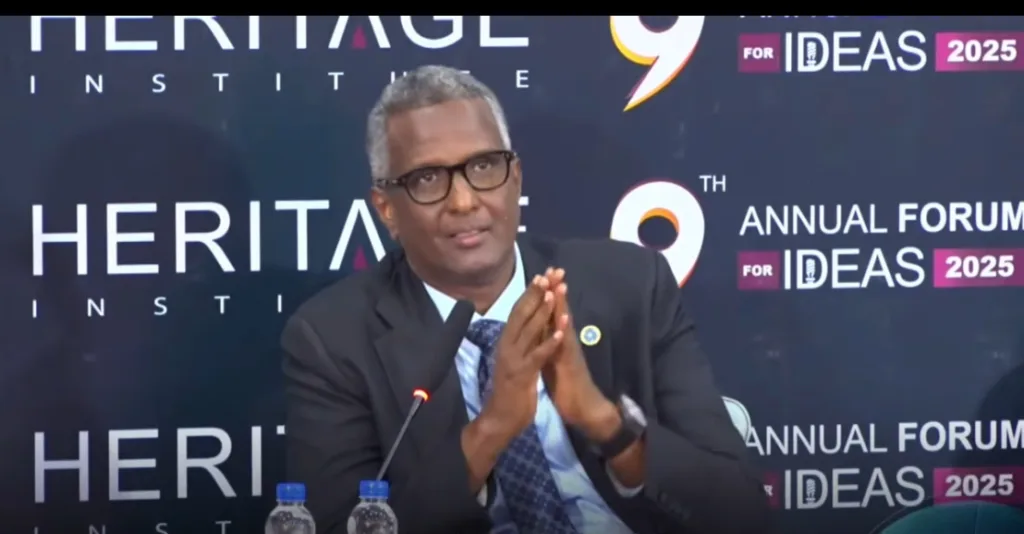
Keynote Speech
At the Hermitage Conference held in Dhusamareb, Mr. Abdirahman Abdishakur, Member of Parliament and leader of the Wadajir Political Organization, and a key figure in the current opposition, addressed the roots of Somalia’s prolonged political conflict.
Mr. Abdishakur argued that Somalia’s crisis is fundamentally a leadership crisis. He described the current Somali Federal Government as confused and unstable, where leadership roles are blurred. According to him, the same individuals attempt to act simultaneously as president, minister, director, journalist, ambassador, and even traditional leader—undermining institutions and accountability.
National Unity and Statehood
He emphasized that national unity is not merely a slogan or an idea, but a concrete goal that requires clear objectives. True unity and sovereignty, he stated, mean the existence of a fully functioning state that guarantees:
- Public safety and security
- Territorial integrity
- National identity and Human dignity
Without these guarantees, government remains an empty claim shared public in the media.
Historical Roots of Fragmentation
Mr. Abdishakur traced today’s fragmentation back to the collapse of the central government in 1991, after which clans and families established their own territorial administrations. Somaliland’s demand for separation, he noted, emerged from this vacuum.
He reminded the audience that Somalia’s unity in 1960 was voluntary, built on patriotism. Leaders from different regions willingly came together in Mogadishu to form a single Somali state.
However, decades of armed conflict—especially in southern, central, and northeastern regions—eventually led to the adoption of federalism, marking a new but deeply contested political phase.
Abuse of Power and Resources
He criticized what he described as family-based governance, where national resources are used to benefit relatives and close allies, creating monopolies over public wealth.
Mr. Abdishakur condemned rhetoric from some Mogadishu-based leaders who claim, “We feed other regions; we are the taxpayers,” calling it political marketing that humiliates other communities. Such language, he said, fuels resentment and undermines national unity.
Leaders from northern regions living in Mogadishu, he added, often face accusations that they are “here to consume resources,” along with intimidation and political harassment.
Institutions and Governance Failures
According to Mr. Abdishakur:
- Government should represent dignity, unity, and resistance against enemies, not favoritism and inequality.
- Parliament has failed to act independently and exercise proper oversight.
- Constitutional reform remains incomplete; chapters passed were never fully adopted.
- The judiciary is not independent and operates under political influence.
- Foreign diplomacy is dominated by a single family network, weakening Somalia’s ability to negotiate foreign investment and resist external interference.
Concentration of Power
He strongly criticized the concentration of power in the presidency, stating that President Hassan Sheikh Mohamuddominates all roles—acting as president, minister, media figure, and administrator—leaving no room for institutional balance.
Urgency of Political Transition
Mr. Abdishakur warned that Somalia faces a dangerous political vacuum within months. Without a legitimate government holding a clear mandate, the country risks:
- Internal conflict
- Increased foreign intervention
- Further erosion of sovereignty
He stressed that only a legitimate, undisputed government after 15 May 2026 can protect Somalia’s independence and prevent external forces from exploiting internal divisions. As my friend Mr Abdirahman Ainte told there is wait and see to somalia
Way Forward
He concluded by calling on Somali citizens and political stakeholders to clearly define the transition of power, restore institutional integrity, and agree on a legitimate pathway forward one that reflects the will of the Somali people and safeguards the nation’s future.