
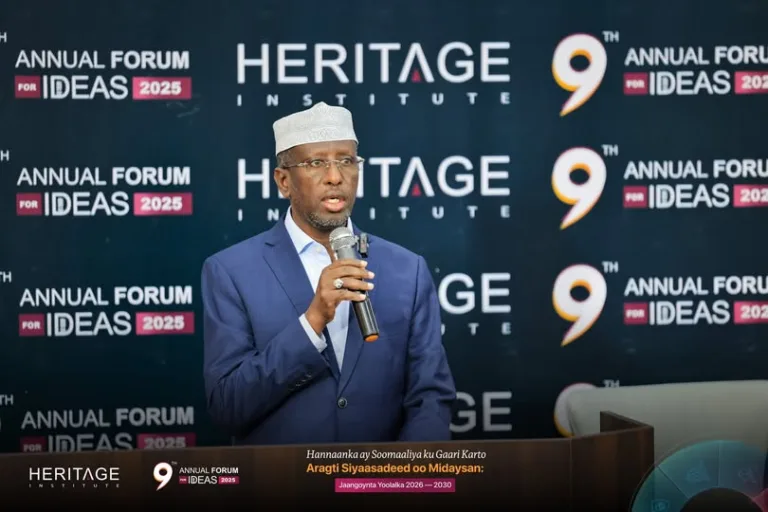
First, I would like to thank the President of Galmudug State of Somalia for hosting us here in Dhusamareb. I also extend my appreciation to the Heritage Institute for organizing the 9th consecutive Policy and Development Studies Forum. I greet everyone present here with Islamic greetings of peace.
The failure of governance and the destruction Somalia has experienced did not come unexpectedly. It was the result of leadership failure at the national level. The importance of unity cannot be overstated. Somalia was once a strong and respected state that contributed to the liberation of other African countries during the colonial era.
In Islam, unity is a top priority for both government and nation. When Somalia lost its unity between the people and the government, the country collapsed, resulting in death, destruction, disasters, and prolonged conflict. Eventually, reconciliation processes began in Djibouti, Ethiopia, and Kenya, which shaped the type of government we have today—through consultation, cooperation, respect, and trust among political actors.
Today, we should be thankful for what we have, even as we acknowledge our shortcomings. Sometimes people confuse institutions with government. The failure of the country has been caused by a lack of respect for institutions and failure to apply laws and regulations. This is something we must address seriously.
The Somali people are united under the Constitution and legislation through common acceptance. No one has the right to misinterpret the Constitution. The extension of leadership terms to five years is a violation of the Constitution. Extensions imposed by force or by the use of armed power can lead to conflict. Constitutional amendments must be based on national consensus and approved through a referendum.
At this moment, the solution is clear: elections must proceed with respect for all stakeholders. Unilateral actions, such as claiming authority to explore oil and other natural resources, cannot justify constitutional violations or wrongdoing.
One of the reasons Somali leaders continue to act improperly is the lack of accountability and public respect for leadership ethics. Additionally, the way federal politicians deal with one another has weakened trust in governance.
Regarding security, the national army must be structured and operated according to clear procedures. Otherwise, we will not have a true national army, and security will continue to deteriorate. Sometimes armed service members themselves contribute to instability when weapons are in human hands without proper discipline and command, posing a serious threat to peace and stability.
Economically, there are serious challenges. While we see construction, real estate development, and roads, these improvements are limited to areas benefiting the elite. The vast majority of the population suffers from severe financial instability, market closures, and poverty. Many people are migrating out of the country due to lack of basic living conditions.
As we face all these problems, we are entering a critical transition period at the end of the government’s mandate. Elections must take place. There is widespread despair and a lack of hope for political stability. Aggressive policies toward Somaliland and other federal member states will not lead us to solutions.
In conclusion, we must compromise and move away from bulletproof jackets and formal suits. Instead, we should return to Somalia’s traditional white garments and sit together under the trees to engage in sincere reconciliation and dialogue—without foreign intervention or aggression. Today, Somalia has more knowledge and resources than decades ago. What is missing is unity and leadership capable of guiding the nation to seize these opportunities.