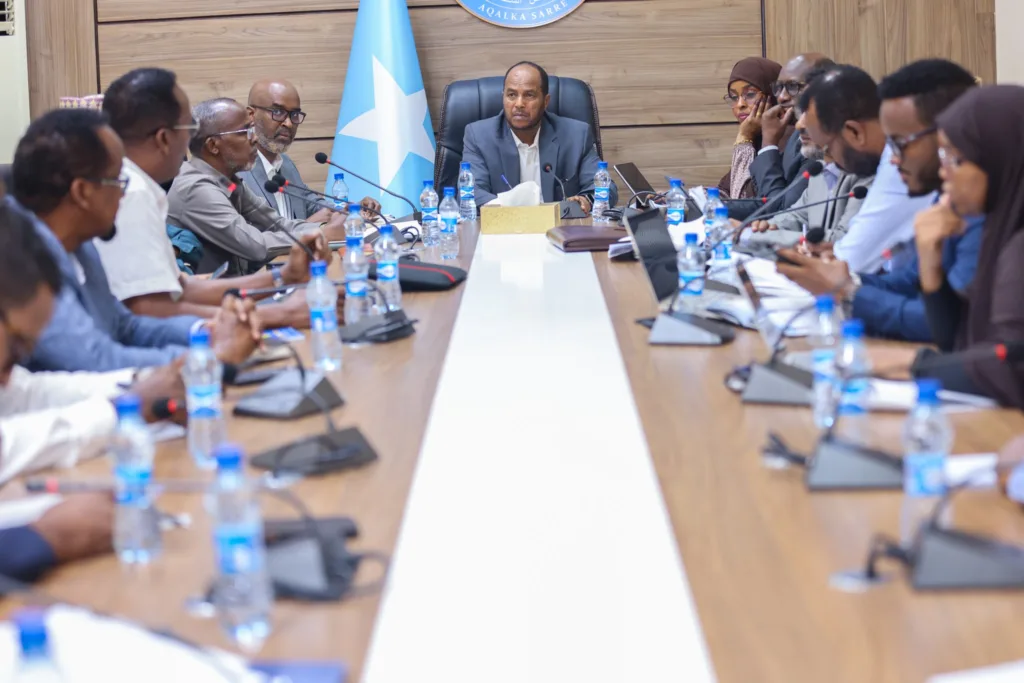
One 29 December 2025 The Somali Parliament’s Upper House Committee on Finance, Economy, Business, Industry, and Tourism is currently reviewing the Somalia National Money Payment and Exchange Draft Bill, which was formally submitted by the Ministry of Finance of the Federal Government of Somalia.
As part of the legislative process, the committee convened a public hearing with key stakeholders from both the private and public sectors, including representatives from Somali private banks and the National Bank of Somalia. The session aimed to gather technical input, concerns, and recommendations regarding the proposed bill.
During the hearing, committee members listened to detailed presentations and feedback from banking sector representatives on the procedures, scope, and implementation mechanisms of the draft legislation. The discussions focused on how the bill would regulate national money payments, electronic transactions, and exchange systems across Somalia.
The committee emphasized that the draft bill is intended to govern both private and public sector financial operations, as well as international banks operating in partnership with local Somali banks. Members of the banking community expressed their commitment to supporting a framework that is nationally applicable while remaining compatible with international financial standards.
Somalia’s banking and financial transactions exceed trillions of dollars annually. Remittances from the Somali diaspora alone amount to several billions of dollars each year, while local business transactions reach hundreds of billions, and government expenditures total several billions of dollars annually.
As a post-conflict country that has endured decades of armed conflict, recurring disasters, and repeated inflationary shocks, Somalia faces a severe shortage of national banknotes. As a result, the country has become heavily dependent on electronic voucher-based currency systems, largely owned and operated by private financial and telecommunications companies.
The proposed National Money Payment and Exchange Bill seeks to address these challenges by establishing a unified national payment framework. The legislation aims to reduce money laundering, counterfeiting, corruption, and illegal banking practices, which currently cost Somali citizens billions of dollars every year. It also responds to the long-standing absence of a fully unified national banking system.
Since the collapse of the former military regime in 1991, Somalia’s national banking infrastructure was destroyed. In its place, the private sector developed financial systems that now manage the majority of personal, commercial, and public finances, including money transfers, savings, and informal insurance mechanisms that dominate the market.
The Upper House Committee reaffirmed that this draft bill represents a critical step toward restoring financial governance, strengthening economic stability, and ensuring transparency and accountability within Somalia’s evolving financial system.